The AI Race Is Accelerating. Professional Services Will Benefit

Read more

In recent months, much of the conversation about artificial intelligence has focused on models.
Which models are most powerful. Which capabilities are improving fastest. Which companies are pulling ahead.
These are legitimate questions. But when AI begins operating in professional environments, another question becomes even more important: Where does the intelligence actually operate?
For AI to meaningfully support professional work, powerful models aren’t enough on their own. AI needs an operating environment. And in professional services, that environment is the workflow.
Professional work happens in workflows
Fields like audit, accounting, tax, and compliance are not simply collections of tasks. They are structured workflows designed to ensure that work is performed consistently, reviewed appropriately, and ultimately trusted.
A typical engagement involves a well-established sequence of steps. Each step builds on the one before it.
These workflows are what allow professional work to be trusted by clients, regulators, and markets.
They provide the structure that ensures complex work is performed correctly.
AI needs structure
When AI begins participating in these environments, it must operate within that same structure.
An AI system analyzing financial data may generate useful insights. But if those insights are not connected to the workflow - to the evidence gathering, documentation, and review processes - they remain isolated outputs.
Professionals still need to determine where the analysis fits within the engagement, how conclusions were reached, what documentation supports the result, and who has reviewed and approved the work.
Without the workflow structure surrounding it, AI cannot fully integrate into professional processes.
This is why workflow systems become so important in the era of AI.
They provide the environment where intelligence can operate within trusted processes.
Workflow systems become the operating environment for AI
As AI systems become more capable, they increasingly need to interact with the full lifecycle of professional work.
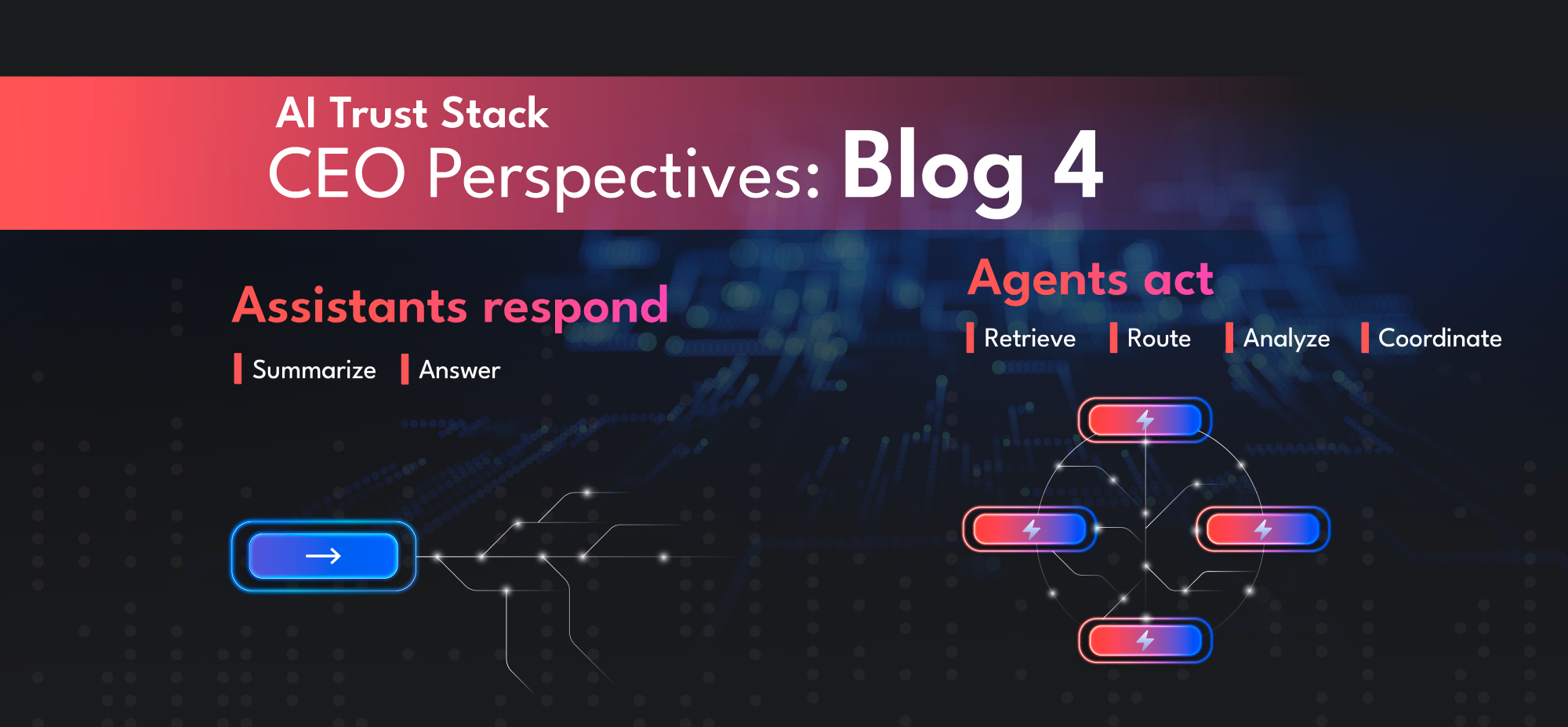
An agent supporting an engagement team might need to retrieve information from prior engagements, analyze current-year data, generate documentation, and route findings for professional review - touching multiple stages of the workflow in a simplified interaction.
Without a system that connects those stages together, it becomes difficult for AI to operate effectively across an engagement.
Workflow platforms solve this problem.
They connect the steps of professional work into a single operating environment - one where AI can access the context of the engagement, understand where work is occurring in the process, and record the actions it performs.
That’s when intelligence starts being embedded in the work itself.
The difference between tools and platforms
This shift also helps explain why professional software is evolving.
Historically, many tools focused on improving individual tasks.
One tool helped extract information from documents. Another analyzed financial data. Another assisted with drafting reports.
Each tool improved a step in the process, and that was valuable.
But AI agents - and the workflows they need to operate within - require something different.
They require platforms that connect the entire process together.
Platforms where data is already structured within the workflow, context from prior engagements is available, documentation is captured automatically, and reviews and approvals are built into the system.
In this environment, AI can support not just individual tasks, but entire engagements. The difference in scope is significant and so are the implications for how professional software gets built and evaluated going forward.
Why this matters for the future of professional software
As the capabilities of AI continue to expand, the systems where professional work happens will become increasingly important.
Intelligence will continue to improve.
Agents will become more capable.
But the platforms that structure professional workflows will ultimately determine how that intelligence is applied in practice.
They provide the context, structure, and governance required for AI to operate within trusted professional environments. Which means the next generation of professional software will be defined not by the power of its AI, but by the quality of the workflow environment that AI operates within.
The next layer of the AI Trust Stack
So far in this series, we’ve explored several layers of the AI Trust Stack: the intelligence layer, where AI models analyze information and generate insights; the emergence of AI agents, capable of performing actions across workflows; and the role of workflow systems as the operating environment for AI.
But there is another layer that may prove just as important.
For AI to support professional judgment effectively, it must also understand the context of professional work. Prior engagements. Professional methodologies. Industry practices. Firm-specific approaches.
In the next article, I’ll explore why professional context may be one of the most valuable ingredients in building intelligent systems that professionals can genuinely rely on.
Because intelligence without context can produce impressive outputs. But intelligence combined with professional context is what allows AI to produce results worth trusting.